
A carton of bare boards lands on a customer’s receiving dock in July. Still, the box looks fine. Inside, one panel has a cracked corner. The pads on a second panel have dulled past their solderability window. And the bag that should have shielded the assembly turns out to be pink poly with no metal layer. However, nobody dropped anything and nothing went to the wrong place. The team simply never wrote a packaging spec. PCB packaging for shipping is the discipline that decides whether boards arrive solderable, flat, and intact.
Short answer up front: four threats set the specification: moisture, electrostatic discharge (ESD), mechanical shock, and contamination. Bare boards ride vacuum-sealed with desiccant. Assembled boards follow J-STD-033 dry pack rules for moisture-sensitive parts. Everything travels in closed shielding bags inside a rigid, cushioned carton. The rest of this article is the pack-out specification we work to on every outbound shipment.
What PCB Packaging for Shipping Must Protect Against?
Short answer: moisture, ESD, mechanical damage, and contamination. Moisture and ESD stay invisible until a board fails at reflow or dies early in the field. By contrast, mechanical damage announces itself as warped panels and cracked corners. Contamination stays quieter, because it simply stops solder from sticking.
Moisture comes first, since FR-4 absorbs water from the surrounding air. The resin and glass layers take in that water during fabrication, transit, and storage. It then flashes to steam during reflow. As a result, the layers can separate (delamination) or blister. In practice, that damage can stay hidden for months before a field failure. Bare boards also carry finishes with real shelf lives. So the bag has to hold a storage condition, not just keep the dust off. IPC-1601, the printed-board handling and storage guideline that IPC-1602 now replaces, exists for exactly this problem.
ESD is the second threat. A discharge of 100 V sits below what a person can feel. Even so, it can still puncture a gate oxide. Boards with MCUs, MOSFETs, and discrete semiconductors count as electrostatic discharge sensitive (ESDS) items. Once the carton leaves the ESD protected area (EPA), nothing else protects the board. Only the packaging stands between it and a charged pallet jack.
Mechanical damage, however, is the visible one. Panels are thin laminates. Flexing cracks corners. Vibration shakes heavy parts loose and slowly works fine-pitch solder joints apart. And warehouse stacking crushes whatever sits at the bottom. Finally, contamination rounds out the list. Fingerprint oils, dust, and airborne sulfur all attack solderability. Immersion silver also discolors on contact with sulfur-bearing materials.
Moisture Control in PCB Packaging for Shipping: MBB, Desiccant, HIC
Short answer: moisture-sensitive parts ship dry-packed per J-STD-033 in a sealed moisture barrier bag (MBB). Fresh desiccant (a drying agent) and a humidity indicator card (HIC) ride inside. The label shows the MSL level, seal date, and floor life.
What a J-STD-033 Dry Pack Contains
J-STD-020 classifies each device’s moisture sensitivity level (MSL). J-STD-033 then sets the handling, packing, and shipping rules that follow. Floor life starts the moment the bag opens. The clock runs against a reference condition of 30 °C and 60 % relative humidity (RH):
| MSL | Floor life out of the bag (≤30 °C / 60 % RH) | Dry pack required |
| 1 | Unlimited | No |
| 2 | 1 year | Yes |
| 2a | 4 weeks | Yes |
| 3 | 168 hours (7 days) | Yes |
| 4 | 72 hours (3 days) | Yes |
| 5 | 48 hours (2 days) | Yes |
| 5a | 24 hours (1 day) | Yes |
| 6 | Time stated on the label | Yes, plus bake before use |
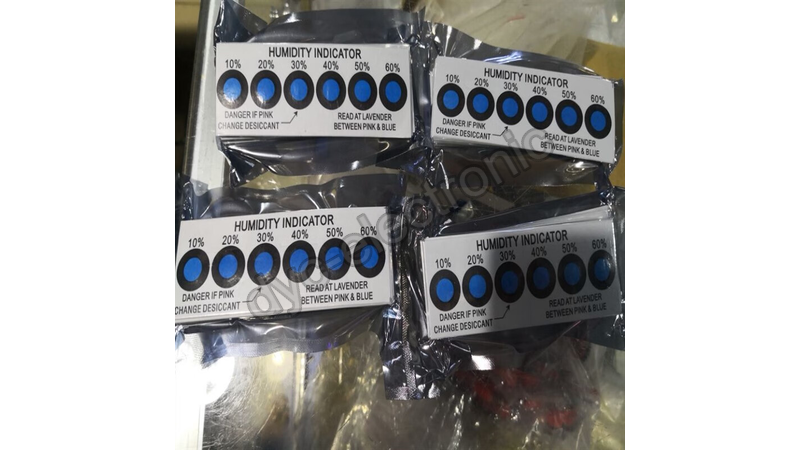
A compliant dry pack has four parts. First, a metal-coated aluminum-foil bag that meets MIL-PRF-81705 Type I forms the barrier. It lets through very little water vapor. The rate sits around 0.02 g per 100 in² per 24 h at 38 °C and 90 % RH. Next, add desiccant per MIL-D-3464 in a quantity sized to the bag volume. A three-spot HIC at 10, 20, and 30 % RH covers MSL 2a–3 parts. For MSL 4–6, the 10 % spot must still read blue when you open the bag. In addition, J-STD-033D Type 2 cards add a non-reversible 60 % spot. If that one has turned, throw the card away and bake the parts. Finally, heat-seal the bag rather than folding it. Put the MSL level, bag seal date, floor life, and quantity on the label.
Field Lesson: A half-used MSL 4 reel sat on a bench over a long weekend. It looked fine, so it went back on the line. The 72-hour floor life had run out two days earlier. Nobody saw the popcorn cracks until the customer’s functional test. Track exposure like you track cash.
PCB Packaging for Shipping: Shelf Life, Baking, and Bare-Board Storage
Storage limits, moreover, matter as much as the pack itself. J-STD-033 gives a sealed dry pack a shelf life of 12 months from the seal date. You get that life when you store the pack at or below 40 °C and 70 % RH. The life can run longer if the HIC still reads under 10 % RH at inspection.
Once floor life runs out, baking restores it. Start at 125 °C for parts rated to take it. A thin package needs hours to about a day. Use 90 °C at 5 % RH or lower for several days. Or use 40 °C at 5 % RH or lower for temperature-sensitive parts and tape-and-reel over one to two weeks. Cap total bake time above 90 °C at 96 hours unless the component manufacturer states otherwise. Always remove parts from the bag before baking, because moisture cannot escape through a sealed barrier.
Bare boards follow a simpler but related rule. They ship vacuum-sealed with desiccant. Boards that have sat through a humid summer in a warehouse need a bake before assembly. Use the IPC-1601 recovery table. In practice, always dry rigid-flex builds and thick multi-layer boards before reflow, whatever the calendar says.
At receiving, the HIC is the first thing we read. Our incoming quality control procedure checks the card, the seal, and the vacuum before a reel moves to stock. The full framework, furthermore, lives in J-STD-033 and the IPC standards library.
ESD Rules for PCB Packaging for Shipping
Short answer: once a pack leaves the ESD protected area, boards need a closed shielding bag. Pink poly is low-charging, not shielding. That substitution is the most common packaging failure we audit.
Material Classes Inside and Outside the EPA
ANSI/ESD S541 sorts packaging materials by surface and volume resistance. Labs measure those values per ANSI/ESD STM11.11, STM11.12, and STM11.13. Similarly, IEC 61340-5-3 carries the same classes. Specifically, IEC 61340-5-1 is the program-level equivalent of ANSI/ESD S20.20. The practical split depends on where the pack will work:
| Packaging material | Surface resistance | Inside the EPA | Outside the EPA / shipping |
| Conductive (trays, foam) | < 1×10⁴ Ω | Yes | Yes, as inserts and carriers |
| Static dissipative | 1×10⁴ to < 1×10¹¹ Ω | Yes | Not on its own |
| Insulative (plain plastic) | > 1×10¹¹ Ω | No | No |
| Shielding bag (metal layer) | Energy penetration < 50 nJ | Yes | Required |
Inside the EPA, low-charging dissipative packaging is enough because the room’s grounding handles fields. Outside the EPA, by contrast, the bag itself has to work as a Faraday cage. That means a buried or surface metal layer bonded to a dissipative inner liner. Energy penetration has to stay under 50 nJ per ANSI/ESD STM11.31. This test result is what a pink poly bag cannot claim, no matter what the print on it says.
PCB Packaging for Shipping: Two ESD Rules That Break Weekly
Moreover, two rules fail every week. First, a shielding bag only protects when someone closes it. A folded-over top is not an enclosure. And one component lead through the wall punches a hole in the cage. Second, pink poly is not a shielding bag. Instead, it is low-charging dissipative polyethylene with no metal layer, fine inside the EPA and useless in a truck. However, the swap usually happens at a shipping desk outside the ESD coordinator’s line of sight. Mark the pack with the ESD susceptibility symbol per ANSI/ESD S8.1. The receiving dock needs to know what it holds. For the controls on our side of the fence, see our ESD protection in SMT guide. The ESD Association publishes the material rules themselves.
Mechanical Protection in PCB Packaging for Shipping
Short answer: boards ship flat, cushioned, and never stacked past the carton’s rated load. Cushioning absorbs drop and vibration energy. Stacking discipline protects the panel at the bottom of the pile.
Road vibration loosens heavy parts such as large electrolytic capacitors. Over a few hundred kilometers, it also slowly works fine-pitch solder joints apart. For example, drop shocks crack corners and delaminate edges. A carton falling off a belt conveyor is a routine event, not an exception. In the warehouse, stacking pressure deforms the bottom carton. That deformed carton then presses directly on the panel stack inside.
Test the pack instead of assuming it. For example, ISTA 3A simulates parcel distribution with humidity and temperature conditioning, random vibration, drop, and shock. Likewise, ASTM D4169 is the general practice for performance testing of shipping containers and systems. ASTM D642 covers compression, and D5276 covers drop. Freight on pallets moves to the ISTA 3E schedule, where stacking and compression dominate the damage modes. If your volume justifies it, qualify the pack once and re-test after any material change.
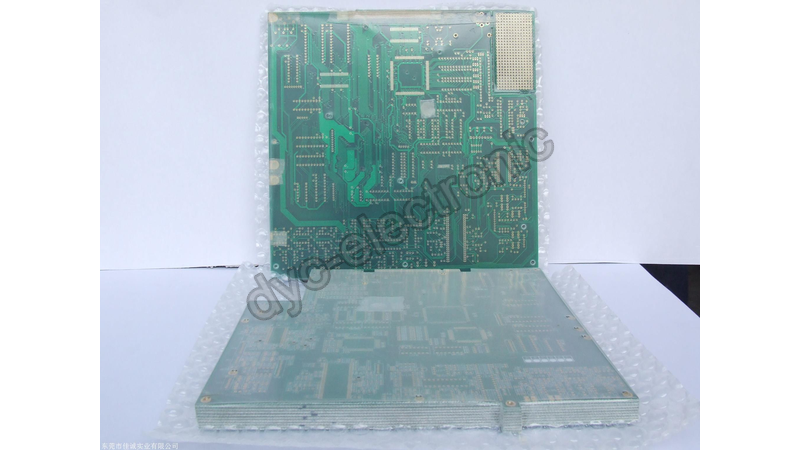
On the line, the rules are simple. First, sandwich vacuum-sealed panel packs between rigid boards so nothing flexes. Next, fill voids with ESD foam or rigid cardboard inserts so the load cannot shift. Keep every panel flat, because edge storage warps boards and a warped panel fails SMT placement. Finally, respect the carton’s stacking mark. For assembled units in transit, our PCBA shipping protection guide covers the outer layers: cartons, pallets, and the truck environment. This article assumes those outer layers are already in place. ISTA and ASTM publish the test schedules.
PCB Packaging for Shipping: Step-by-Step Workflow
Short answer: bake if required, then bag it closed and dry. Cushion, box it rigid and flat, label completely, and qualify the pack before the first shipment. Eight steps cover the whole chain.
- Check moisture status first. Read the HIC and the seal date on incoming material. Confirm the board’s storage history before you pack anything.
- Bake when required. Bare boards past their storage window, and parts past floor life, need a recovery cycle first. Use the cycle in J-STD-033 or the IPC-1601 table.
- Bag it dry. Bare boards go into a vacuum-sealed MBB with fresh desiccant. Moisture-sensitive parts on assembled boards go into dry pack with a new HIC. Heat-seal or fully close every bag.
- Cushion. Rigid inserts or ESD foam separate panels and fill voids so the stack cannot shift or flex.
- Box it. Use a rigid carton, load it flat, center the stack, and add padding top and bottom.
- Label it. The moisture block (MSL, seal date, floor life), ESD symbol, RoHS mark, and handling marks, every carton.
- Record it. Photograph the sealed bags, and log the HIC reading, seal date, and operator at pack-out. That record is what settles a claim three weeks later.
Therefore, if your pack-out specification is already written, send it with your RFQ. We check it against this list before the first purchase order, not after the first claim.
Labels Every PCB Packaging for Shipping Plan Needs
Short answer: four blocks minimum. The moisture block (MSL, seal date, floor life), the ESD susceptibility symbol, the RoHS mark, and handling marks. A pack without a seal date gives nobody a way to check it. That kind of pack is an argument waiting to happen.
Specifically, the moisture block follows J-STD-033: MSL level, bag seal date, floor life, and quantity. Add the bake requirement once someone opens the bag. Put it where anyone can read it without opening the bag. That window side is the natural spot. The ESD susceptibility symbol per ANSI/ESD S8.1 goes on the shielding bag, and again on the carton. Receiving docks see the carton, so it needs the mark too. The RoHS or lead-free mark belongs beside it for any board you build to lead-free specifications. Handling marks finish the set: keep dry, this side up, and do not stack. Add the stacking limit if the carton has one.
So one habit pays for itself: record the HIC reading and seal date at pack-out, with a photo. When a carton arrives three weeks later with a pink card inside, that record decides the outcome. It separates a warranty claim from a scrap decision.
Shelf Life Limits in PCB Packaging for Shipping
Short answer: the surface finish sets shelf life. Plan on roughly 3–6 months for OSP, and 6–12 months for immersion silver and immersion tin. HASL runs 12–18 months, and ENIG can reach 36 months under sealed storage. Nevertheless, packaging protects shelf life; it cannot extend it.
| Surface finish | Typical sealed shelf life | Storage sensitivity | Packaging requirement |
| OSP | 3–6 months | Very high | Moisture barrier critical; nitrogen flush helps |
| Immersion silver (ImAg) | 6–12 months | High | Sulfur-free, pH-neutral materials only |
| Immersion tin (ImSn) | 6–12 months | Moderate–high | MBB plus desiccant |
| HASL | 12–18 months | Low | Standard vacuum seal |
| ENIG | 12–36 months | Moderate | Standard MBB acceptable |
These ranges come from industry guidance based on IPC-1601, and they vary by supplier. Treat them as planning values, and confirm against your own storage data. Two practical notes follow. First, boards opened from their pack typically carry a 125 °C / 4 h bake recommendation before assembly. That applies when someone broke the seal long ago. Second, immersion silver in particular discolors on contact with materials that carry sulfur. That is why the packaging spec, not the finish, is usually the root cause. The “finish failure” shows up at receiving, but the pack caused it. IPC-1602 has since replaced IPC-1601, so check which revision your purchase orders use.
PCB Packaging for Shipping: Mistakes We See at Receiving
Short answer: five failures account for most damaged shipments. Watch for pink poly substituted for shielding bags, reused desiccant, ignored HICs, over-stacked cartons, and missing seal dates.
- Pink poly as a shielding bag. The carton arrives with an antistatic bag that stops nothing. Ask for the bag specification on the purchase order, not just the word “anti-static.”
- Reused desiccant. Silica gel that has already been through one cycle still holds water. Dry it out in a dedicated oven or instead use fresh units. Never judge a hidden packet by its color alone.
- An ignored HIC. A pink 10 % spot on an MSL 4 bag means bake, not opinion. Therefore, receiving needs the authority to hold the lot. You also need to see the HIC without opening the bag.
- Over-stacked cartons. The bottom carton of a six-high stack carries hundreds of kilograms by the end of a sea voyage. Respect the stacking mark and the carton’s rated compression.
- Missing seal dates. Without a seal date and a floor-life label, nobody can prove whether a dry pack stayed inside its shelf life. Thus, the label is the audit trail.
Overall, every one of these is cheap to prevent and expensive to discover at reflow. If a shipment has already gone wrong, our PCBA shipping protection write-up covers the claim and recovery path.
FAQ
How should PCBs be packaged for shipping?
Bare boards vacuum-sealed in a moisture barrier bag with desiccant. Assembled boards in closed ESD shielding bags, with moisture-sensitive parts dry-packed per J-STD-033. The whole stack cushioned, flat, in a rigid carton with a complete label set.
What is dry pack, and when is it required?
Dry pack is a sealed MBB, fresh desiccant, and a HIC. Use it for any part that carries an MSL of 2 or higher. MSL 1 parts do not soak up moisture and need no dry pack. The pack also needs a label showing the MSL level, seal date, and floor life.
Can I reuse a moisture barrier bag or a shielding bag?
A shielding bag can work again if the seal still holds and the bag has no holes. Test it first, because one lead through the wall ends the Faraday cage. Do not reuse a moisture barrier bag once you open it. Its barrier layer creases and picks up tiny holes easily. Never reuse desiccant unless you re-dry it first.
How can I tell whether the packaging failed in transit?
Read the HIC first: a pink 10 % spot means the parts saw humidity and need evaluation or baking. Then check the seal and the vacuum; a loose bag has lost it. Check the carton for crush and puncture damage, and the panels for warped corners. Photograph everything at receiving.
Do you provide ESD-safe packaging and MSL dry pack?
Yes. Boards leave our floor vacuum-sealed with desiccant in moisture barrier bags. Assembled units leave in closed shielding bags. We label every carton with the moisture block, ESD symbol, and handling marks.
Ultimately, PCB packaging for shipping is a specification, not an afterthought. Control moisture with dry pack per J-STD-033, and control ESD with closed shielding bags per ANSI/ESD S541. Flat, cushioned, tested packs per ISTA 3A and ASTM D4169 handle mechanical risk. Labels and a pack-out record control the argument. None of it is expensive, and all of it is cheaper than one scrapped lot.
Specifically, we build this into every shipment. Our floor runs 6 Yamaha YS series SMT lines and 6 AOI stations under ERP-managed material control. Capacity sits at 6 million PCBA a year. A pack-out checklist goes out with your quote.
 Deutsch
  English
  Русский
  Français
  日本語
日本語  한국어
한국어  Español
  Português
  العربية
  Türkçe
  Italiano
  Polski
  Dansk
Dansk