
A procurement lead forwarded a quote that looked 30% below the field. Two weeks later the invoice arrived with a stencil charge, an expedite fee, and a component overage they had never seen. An accurate PCBA quote starts long before the price — it starts with the files you send. Send four things upfront and the number holds: complete manufacturing data (Gerber or IPC-2581), a bill of materials with real manufacturer part numbers, a pick-and-place/centroid file, and your test plus IPC-class requirements. We have reviewed thousands of RFQs, and the lesson repeats: complete packages quote in hours, incomplete ones drift by 20% or more before the first board ships.
Short answer up front: a supplier prices a PCBA quote from your design files, not from a catalog. Missing files force assumptions, and assumptions become change orders. Give them the four inputs below and ask for an itemized breakdown, and you remove most of the surprise.
What Actually Drives a PCBA Quote?
Short answer: the bill of materials dominates. Industry cost breakdowns put components at 50–70% of the total, with bare-board fabrication, assembly labor, test, and one-time NRE filling the rest. Therefore, the fastest cost lever is your BOM, not the assembly rate.
Across 2026 supplier data, the split is remarkably consistent. Components usually run 50–70% of the total because IC pricing and lead time sit outside the factory’s control. Bare-board fabrication lands at 10–20%, shaped by layer count and material. Assembly labor (SMT and THT) takes 8–15%, test and QC 3–10%, one-time NRE/tooling 3–8%, and logistics plus packaging 2–5%.
| Cost element | Typical share | What moves it |
| Components (BOM) | 50–70% | IC pricing, lead time, single-source premium |
| Bare PCB fabrication | 10–20% | Layer count, material, surface finish |
| SMT / THT assembly | 8–15% | Placement count, fine-pitch, double-side |
| Test & QC | 3–10% | AOI, X-ray, ICT, FCT scope |
| NRE / tooling (one-time) | 3–8% | Stencil, fixture, programming |
| Logistics & packaging | 2–5% | ESD pack, freight, tariffs |
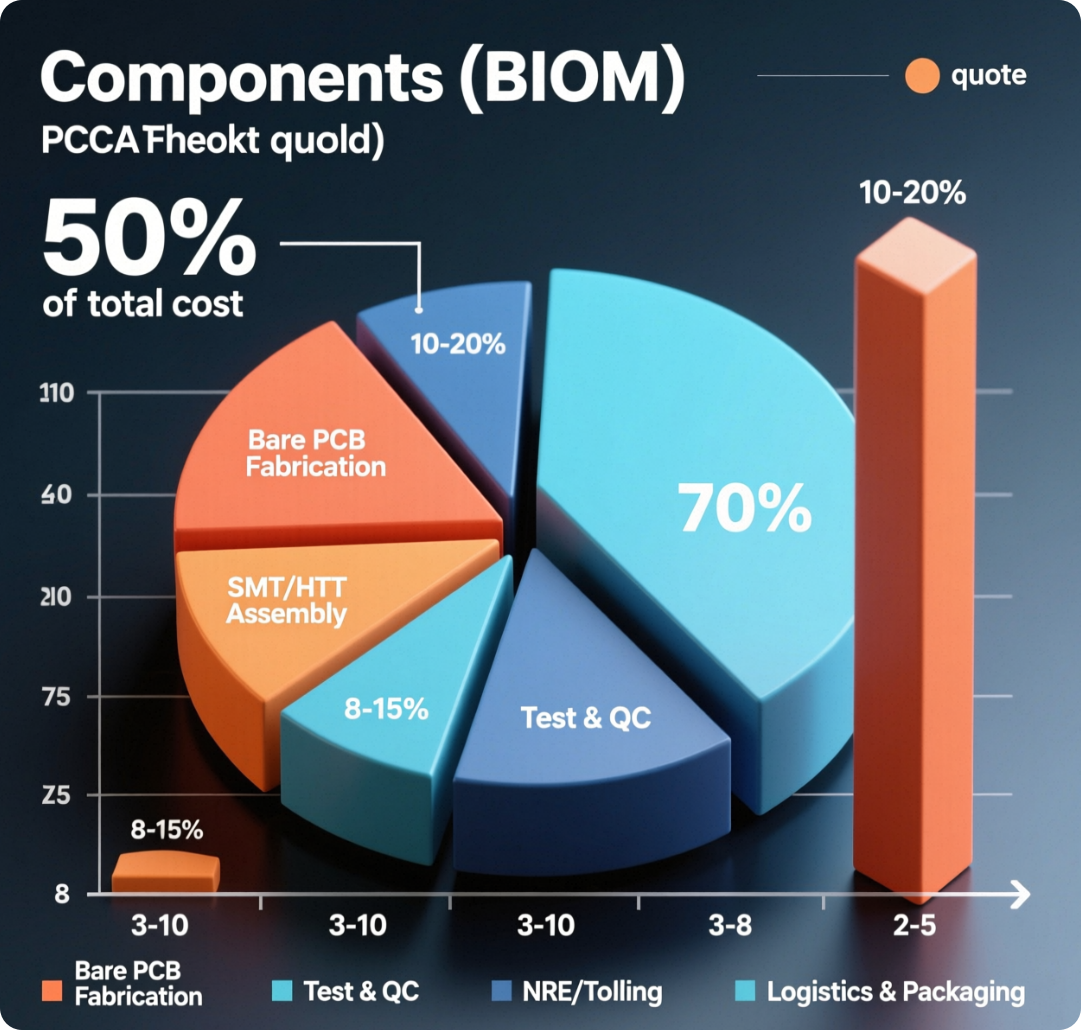
Critically, a 10% cut in component cost beats a 30% cut in assembly charges, simply because the BOM is the largest bucket. That is the point to remember when two PCBA quotes look different: compare the BOM line first.
What Files You Must Send for an Accurate PCBA Quote
Short answer: the four inputs above, plus your PCB specs and quantities. A BOM without manufacturer part numbers can misprice components by 20% or more, because the sourcing team has to guess a price band. Consequently, file accuracy is the cheapest insurance you have.
A practical RFQ package contains these fields. The GNS RFQ checklist maps fifteen of them, but the non-negotiables are the first four:
- Manufacturing data — Gerber (RS-274X), ODB++, or IPC-2581; all copper, mask, legend, drill, and routing layers.
- BOM with MPNs — reference designator, quantity, manufacturer, manufacturer part number, description, package, and approved alternates.
- Centroid / pick-and-place file — X, Y, rotation, and side for every component; without it, SMT programming is rebuilt from Gerber and NRE climbs.
- Assembly drawing — fiducials, panelization notes, polarity marks, and any manual steps not visible in Gerber.
- PCB specs — layer count, thickness, copper weight, surface finish, material, controlled impedance.
- Quantities — prototype volume and 12-month forecast, since MOQ and tooling amortization depend on the horizon.
- Sourcing model — turnkey, consigned, or partial; this decides who carries component risk.
- Test requirements — AOI, X-ray, ICT, FCT, burn-in, and the IPC class (2 or 3) you build to.
Procurement Tip: Send the forecast even on a 20-piece prototype. A supplier who knows a 5,000-piece run follows can plan component buys realistically and quote the prototype without a low-volume penalty baked in.
The Cost Breakdown You Should See on the Quote
Short answer: insist on an itemized PCBA quote that separates one-time NRE from recurring unit cost. For a mid-complexity 4–6 layer board at 500–1,000 units, AtlasPCB’s 2026 breakdown shows components at $15–80 per board, bare PCB $2–8, SMT $3–12, test $1–5, NRE amortized $0.50–3, and logistics $0.50–2. That granularity is what lets you compare two shops honestly.
A vague single total forces assumptions that rarely favor the buyer. Ask for the BOM cost as its own line so you can check part pricing across suppliers instead of judging the bundle blind. The data-exchange standard behind a clean file package is IPC-2581; the acceptability yardstick for the built board is IPC-A-610, with Class 2 for standard electronics and Class 3 for high-reliability automotive, medical, and aerospace work. A partner who cannot name the IPC class they build to has an unclear quality system.
Hidden Fees That Inflate Your PCBA Quote
Short answer: NRE/setup (150–300 one-time), stencil (30–100), ICT fixture (200–1,500), expedite (+20% to +300%), impedance control (+10–15%), component attrition (2–5% of BOM), low-volume lot charge (50–200), and freight plus tariffs on offshore builds. Always ask for line-by-line itemization before you issue a purchase order.
These labels shift between factories. “Setup fee,” “tooling charge,” and “processing fee” all describe the same machine-prep work. An expedite quote may carry a 300% premium, yet the factory clock often starts only after components arrive — which can be ten days of silent waiting. Impedance control slips into the bare-board section if you forget to state it in your Gerber notes. QueenEMS’ fee breakdown lists the typical ranges so you can spot the gap between the headline number and the final invoice.
That said, not every add-on is a trap. A stencil you own is recoverable tooling, and a well-specified ICT fixture pays for itself by catching faults before shipment. The difference is whether the charge is visible and labeled, not whether it exists.
Turnkey vs Consigned: Which Quote Model Fits?
Short answer: below roughly 250 boards, turnkey usually wins because the assembler pools demand and avoids cut-tape premiums; above that, consigning high-value parts while they source passives starts to save markup. Watch the BOM line either way — turnkey markups run anywhere from 5% to 100%.
A turnkey PCBA quote means one invoice and one throat to choke; the assembler procures everything and bills it. At low volume this is almost always more efficient, because they pull from an in-stock library instead of paying cut-tape premiums on every reel. Consigned hands component quality control, kitting, and shortage risk back to you — fine when you hold proprietary or long-lead parts, costly when you manage partial reels yourself. We usually steer prototype and medium-mix runs toward turnkey and review the BOM line openly, because transparent cost control is where most savings actually live.
How to Compare Two PCBA Quotes Fairly
Short answer: compare at your real volume, on equal scope — same test plan, same IPC class, same lead time. A low assembly rate without ICT or DFM review is no bargain if failures reach your customers. Match the cost structure to your stage, and the cheaper number may flip.
A supplier with high NRE but low unit cost wins at volume; a low-NRE shop suits prototypes. The trap is comparing a showcase quantity against your actual one — a quote that looks expensive at ten pieces may beat a cheap prototype rate at ten thousand. Equal scope is the rule: if your product needs full AOI, X-ray on BGA, and functional test, the lowest rate without them simply moves the cost downstream as rework. Strong incoming quality control and test discipline is the line item that protects margin long after the PO is signed.
A Practical RFQ Checklist for Your PCBA Quote
Short answer: assemble the package before you request the price, not after. Five steps close most gaps before a supplier has to guess. Ultimately, the quote you get is only as accurate as the files you send.
- Export complete Gerber/ODB++/IPC-2581 with every layer and the stack-up.
- Build the BOM with MPNs, quantities, packages, and at least one approved alternate per critical part.
- Generate the centroid file with X/Y/rotation/side matching the BOM designators exactly.
- State quantities (prototype + forecast), sourcing model, test plan, and IPC class.
- Request an itemized quote that separates NRE, stencil, component, assembly, test, and freight.

FAQ
What is the fastest way to get an accurate PCBA quote?
Send the four core files — manufacturing data, BOM with MPNs, centroid, and test/IPC-class specs — in one package. Complete RFQs quote in hours; partial ones bounce back for missing data and drift as assumptions pile up.
Why does my PCBA quote vary so much between suppliers?
Different scopes hide behind similar totals. One shop may exclude ICT, stencil, or impedance control, while another includes them. Compare the itemized lines at your real volume and equal test scope, not the headline number.
Do you provide free PCBA quotes and DFM review?
Ask this directly, because a factory that hands you a price without reviewing your files is a red flag. A free DFM review catches panel-utilization waste and single-source parts before they inflate the BOM.
What standards should a PCBA quote reference?
Expect IPC-2581 for data exchange, IPC-A-610 for acceptability (Class 2 or 3), and RoHS (EU) 2015/863 for restriction of hazardous substances. ISO 9001:2015 is the baseline quality system; IATF 16949 and ISO 13485 apply to automotive and medical work.
Conclusion
Overall, an accurate PCBA quote is a file problem before it is a price problem. Send Gerber or IPC-2581, a BOM with real part numbers, a centroid file, and your test plus IPC-class requirements, then demand an itemized breakdown that separates one-time NRE from unit cost. Industry data puts components at 50–70% of the total, so the BOM line deserves the most scrutiny — and the hidden fees worth naming are stencil, expedite, impedance, attrition, and lot charges.
At DYC Electronic, our ERP-managed material control and 6 Yamaha YS SMT lines let us return an itemized PCBA quote with a free DFM review, usually within one business day.
Talk to Spancer Huang on WhatsApp +86 15818610980 or email info@dyc-electronic.com for a free PCBA quote and a competitive, itemized breakdown — and send the four files above before you ask for the number.
 Deutsch
  English
  Русский
  Français
  日本語
日本語  한국어
한국어  Español
  Português
  العربية
  Türkçe
  Italiano
  Polski
  Dansk
Dansk