
Thinking back, we’ve been burned before. Back in 2012 our shop took an overseas order; we asked the customer what their requirements were, and in the end we shipped the PCBA over, and the customer came back holding the IPC-A-610 standard telling us a third of the solder joints failed.
Was it that our capability fell short? Honestly, no. It’s that we never nailed down the words “acceptance class” in the contract. We released to the default standard; they inspected the goods to the high-reliability standard — how could those be the same? Only later did I fully get it: IPC isn’t a manual lying on the desk, it’s the common language the whole electronics manufacturing circle uses to align on “what counts as acceptable.” You talk quotes, you talk acceptance, you talk rework — if you haven’t got this standard down cold, the communication cost multiplies like crazy, and the bickering will make you question your whole life.
Today let’s talk through this IPC standard and my take on it — if anything’s off, feel free to correct me.
First Thing Before Starting Work: Lock Down the “Shipment Requirement Sheet”
Now when we take an order, my very first question is always to the sales rep and the engineer: which IPC class is this board inspected to?
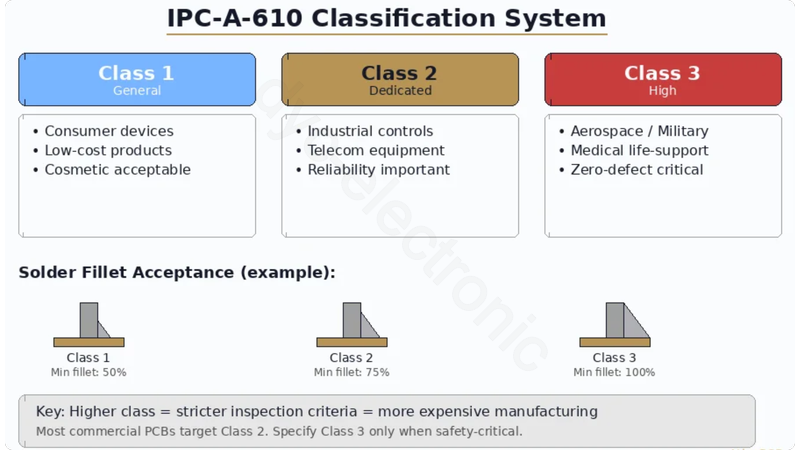
Class 1: general electronics, works and that’s enough, failure won’t cause big trouble.
Class 2: dedicated service class, requires continuous operation and long life; most consumer electronics are fine with this.
Class 3: high-reliability products — medical, aviation, military, automotive safety parts. If this kind of board drops, people die, so the acceptance margin is pinned down brutally tight.
Get the class wrong, and either you over-process and lose your shirt, or you leave a hidden hazard waiting for the customer to claim against you. In our shop now, every high-requirement, high-standard board is inspected to IPC-A-610 Class 3 across the board, and the SPI and AOI judgment thresholds are all tuned to this class — we dare not be sloppy by even half a bit.
From Design to Shipment: How IPC “Shadows” the Whole Process
A lot of people think IPC only governs solder acceptance — that’s way too naive. It’s a one-stop service; whichever link drops the ball, everything downstream suffers for it.
1. Design stage: don’t wait till the board comes back to slap your thigh The first gate of DFM review for me is checking the spacing margin against IPC-2221. Trace width and spacing, annular ring — all the underlying rules are in this book. Then there’s IPC-7351, which governs the land pattern; whether a component sits straight, whether it tombstones — that’s hugely tied to it. As for IPC-2581, that’s the data-exchange standard that replaces the old Gerber, structured transfer, saves you from a pile of data-conversion pitfalls. If design doesn’t follow these, soldering and acceptance downstream are all landmines.
2. Bare board into the factory: before the board even gets parts on it, run it through the sieve first The board material has its own “physical exam report” too. IPC-4101 governs copper-clad laminate properties; IPC-6012 is the rigid PCB acceptance spec; IPC-A-600 is even better — it gives you diagrammatic comparison, what each defect looks like at a glance. Our IQC inspecting bare boards works right off these standards — if the board itself is non-conforming, mounting the best components is still a waste.
3. Assembly and soldering: process and acceptance are two different things! Knock on the blackboard, mark the key point: J-STD-001 and IPC-A-610 are used together, but what they govern is completely different! J-STD-001 governs “how to solder”: soldering process, material selection, process requirements — this is the operating baseline for the line workers to look at. IPC-A-610 governs “how to verify after soldering”: acceptability of electronic assemblies — this is the acceptance standard for QC and the customer to look at. One governs the process, one governs the result. Whatever you do, don’t conflate them — otherwise when the customer asks “what’s your soldering process basis,” and you toss over an acceptance standard, your professionalism drops straight to zero in the customer’s mind.
4. Rework and salvage: don’t mess around by feel When a board has a defect and needs fixing, you can’t rely on the old master’s “muscle memory.” IPC-7711 covers rework of through-hole and SMT parts; IPC-7721 covers mod wiring and repair. And remember one thing: after rework, the acceptance standard still goes back to IPC-A-610. A lot of shops don’t re-judge by Class after repair — that’s planting a mine, and it’ll blow up sooner or later.
5. Test verification: saying it’s good doesn’t count, only measuring it does IPC-TM-650 is the test methods manual — peel strength, insulation resistance, ionic contamination, how to measure them all in there. It doesn’t directly tell you where the “pass line” is, but it specifies “how you prove you’re good.” Our incoming inspection and process inspection reference this manual’s methods heavily.
One Table to Help You Sort It Out (I’ve Got It Taped Up at My Workstation)
| Stage | Core IPC Standard | Scope | Note |
| Design | IPC-2221 / 7351 / 2581 | rules, land pattern, data exchange | must-read for DFM review |
| Board material | IPC-4101 / 6012 / A-600 | base material, bare-board acceptance | basis for IQC incoming inspection |
| Assembly | J-STD-001 | soldering process requirements | source of line work instructions |
| Acceptance | IPC-A-610 (Class 1/2/3) | assembly acceptability | the only yardstick for customer acceptance |
| Rework | IPC-7711 / 7721 | rework and mod | after repair still inspect to A-610 |
| Test | IPC-TM-650 | test methods | must-have for lab / QA dept |
A Few Questions I Get Asked to Death — Unified Reply
Q: Do consumer electronics also need to follow IPC? Strongly recommend at least IPC-A-610 Class 2. It’s not mandatory, but with a unified baseline, after-sales bickering and hidden failures drop by more than half. Don’t skimp on that bit of mental cost.
Q: Where is Class 3 stricter than Class 2? Stricter in the acceptance margin. Annular ring wetting, solder-ball density, ionic cleanliness, bow-and-twist limits — tightened across the board. It’s aimed at those “failure-is-not-allowed” scenarios.
Q: How do you tell if a shop is really working to IPC? Don’t just listen to what they say. Look at whether their acceptance records write down which Class, and what standard revision number they cite; look at whether the SPI/AOI/ICT/FCT judgment thresholds are really set to that class. Empty talk of “we work to IPC” without reporting the revision and class is about as good as saying nothing.
Q: How often are IPC standards updated? The major standards get revised every few years — for example IPC-A-610 is now at Rev J. When signing contracts and writing reports, you must note the revision year; inspecting new-version goods with an old revision, or vice versa, is digging a hole for yourself either way.
Written at the End: Align the “Scale” Before You Talk Business
At the end of the day, IPC is that “scale” of electronics manufacturing from design to acceptance. Design looks at 2221/7351/2581, board material at 4101/6012/A-600, soldering at J-STD-001, acceptance at A-610, rework at 7711/7721, testing at TM-650.
In our shop now, all high-reliability orders are strictly inspected to IPC-A-610 Class 3, the soldering process is aligned to J-STD-001, and DFM and incoming inspection cite IPC-2221 / IPC-TM-650.
 Dansk
 English
 Русский
 Français
 Deutsch
 日本語
 한국어
 Español
 Português
 العربية
 Türkçe
 Italiano
 Polski