
A first article is not one sample you build and show around. Wire harness first article inspection is the point where the drawing, the BOM, the terminal, the reel, the die set and the test program all land on one physical loom — and where someone signs that the evidence matches. Get that step wrong and a clean first build still turns into a latent open two months into a field run.
WHMA calls IPC/WHMA-A-620 the only industry-consensus international standard for the performance and acceptance of cable and wire harness assemblies. It supplies the acceptance criteria. It does not tell you how often to inspect, who releases the line, or what to do when a reel changes lot. That work is a first article inspection job, and on harnesses it looks different from SMT first article inspection.
Here’s the catch: most teams treat FAI as a customer form to fill and file. More than once, a signed FAI has shipped with the wrong drawing revision, a borrowed crimp die and a test program that never checked the circuit that mattered. Paperwork looked perfect. Hardware told a different story.
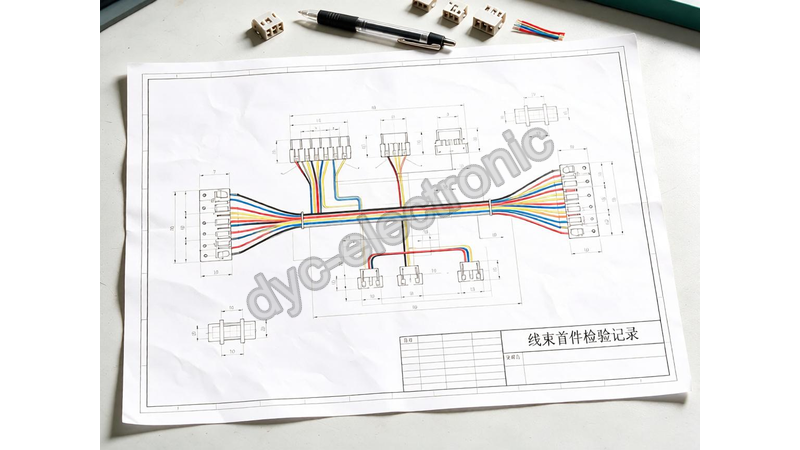
What Wire Harness First Article Inspection Actually Checks
Four inputs, one loom. Wire harness first article inspection checks that the released drawing revision, the material lot and its certificates, the tooling setup and the test program all describe the same physical build. Miss any one and the sign-off is a photograph, not evidence.
Start with the document set. The drawing revision, the BOM, the terminal part numbers, the wire style and AWG, the connector part numbers and every special requirement have to point at the same revision. One build we rejected had a drawing that named one backshell and a kit that held another. Crimps looked fine. That housing would not seat.
Then the material. Match the reel print and lot to the certificate, the UL file number to the current record, and the insulation to what the drawing calls out. Our incoming quality control step already does some of this. FAI repeats it on the exact pieces going into the one loom, because a lot can move between delivery and build.
Wire Harness First Article Inspection Starts at the Print
Read the print before anyone touches a stripper. That order matters more than it sounds, because a harness built to an old revision is scrap the moment the correct drawing arrives.
That order is deliberate. Operators pull the released drawing, check the revision field against the traveler, and lay the BOM beside it. Only then does the loom get built. Inspectors who build first and match the paperwork later tend to explain away mismatches. “Same connector, different dash number” is how a wrong part reaches production.
That same discipline carries over from SMT, but harness adds a geometric layer. A board is flat. Finished looms take a three-dimensional route through a cabinet, and the drawing rarely fixes every bend. So the print has to be read together with the enclosure it will live in.
The Crimp Record in Wire Harness First Article Inspection
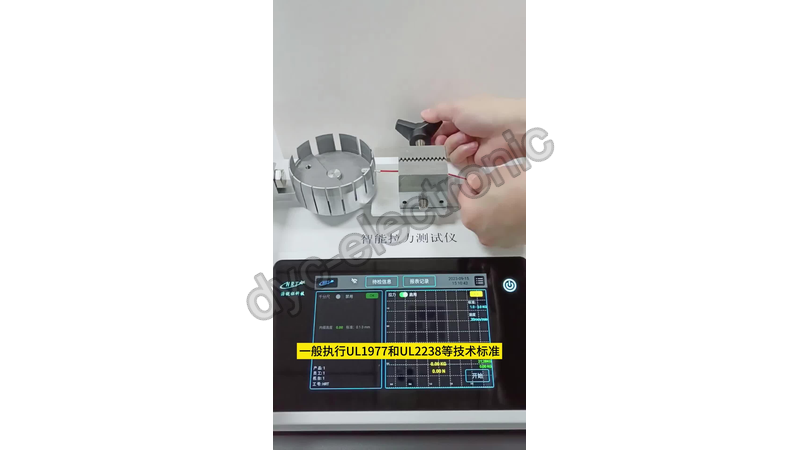
Crimp height and pull force are the two numbers people remember. Wire harness first article inspection needs more than two numbers: the terminal part number, the wire structure and AWG, the die set, the measured crimp height, the pull-test result and a cross-section showing the strands compressed without being cut.
Pull force must meet the IPC/WHMA-A-620 minimum or the customer’s tighter spec. We do not invent a figure here. A strip tolerance near ±0.3 mm and a crimp height held around ±0.02 mm are common starting points in general harness work, but the terminal drawing and the connector specification decide the real window. Write that window into the record.
Worse still, one die set can make an acceptable crimp on one reel and an open on the next. Wall thickness moves the finished diameter, and a die that gripped one construction may not grip another. We re-cut the crimp first article whenever the wire part number changes, even at the same AWG. Our wire harness vs cable assembly page explains why the construction matters more than the colour.
Wire Harness First Article Inspection on the Form Board
Routing is the real job here, not just connecting conductors. On the form board, wire harness first article inspection checks branch point location, lead length, bend radius at each break, connector clearance and the position of every clip or tie. A netlist cannot see any of it.
In practice, the form board itself is part of the first article. If the pins have shifted even 1 mm, or the board was built to an old revision, a perfect loom comes off it in the wrong shape. We photograph the board with the first loom on it and keep both with the record. That habit has saved us more rework than any checklist.
Cable assemblies heading into PCBA box build carry the same problem one level up. The loom has to fit a chassis that nobody mocked up during routing. Check clearance against the real enclosure, not the drawing alone.
Electrical Evidence in Wire Harness First Article Inspection
Continuity is a comparison, not a beep. Wire harness first article inspection runs the finished loom against the netlist in both directions: every circuit that should be closed, and every pair that should stay open. Meters that beep at one end and stop tell you very little about a mis-pinned connector.
The fixture is part of the evidence. Its program revision, the adapter and the known-good and known-bad checks all belong in the record. We run a deliberately wrong loom through the fixture before we trust a pass. Fixtures that have never seen a failure will happily pass one.
Hipot and insulation resistance follow the customer specification and the insulation rating. We do not apply a generic 500 V rule to every harness. Thin-wall wire at 80 °C and a 105 °C construction do not share a setpoint, and the drawing should say which one applies. Our PCB testing methods page covers board-side testing; the harness needs its own program.
Wire Harness First Article Inspection Record: What Gets Measured
Six rows cover the first build we see most. Read across for what to measure, the basis for the call and what a shortcut costs later.
| Record item | Basis for the call | What a shortcut costs |
| Drawing revision and BOM | Released revision against the traveler | Wrong connector or backshell reaches production |
| Wire and terminal lot | Reel print, certificate, current file record | Traceability gap; rework scope grows at recall |
| Crimp height and pull force | Terminal drawing, A-620 minimum, customer spec | Latent open that endurance testing misses |
| Form board geometry | Branch point, lead length, bend radius | Loom will not seat in the real enclosure |
| Netlist continuity | Two-direction circuit comparison | Mis-pin passes a one-way beep test |
| Hipot and insulation | Customer spec and insulation rating | Over-stress damage or an untested safety margin |
Source: WHMA’s description of IPC/WHMA-A-620 as the consensus acceptance standard for cable and wire harness assemblies, plus the released drawing, the terminal and wire specifications and the customer’s own test requirements for the build in question. Treat these as record headings, not limits. Use the revision, the datasheet and the customer spec on the actual program. Do not order from this table.
Releasing Production After Wire Harness First Article Inspection
An approved first article is not a production release. Wire harness first article inspection proves that one loom can be built right. Releasing the line needs a control plan, an inspection cadence, trained operators and a rule for when the FAI must be run again. WHMA describes A-620 as a foundation for requirements flowdown between an OEM and its supplier, and that flowdown is where the cadence and the acceptance class get fixed.
Class 1, 2 or 3 has to be named on the drawing with a revision. Saying “built to A-620” without a class gives an inspector nothing to accept against. We have seen a Class 2 build judged against Class 3 expectations at final inspection, which is an expensive way to discover a paperwork gap.
Change is the usual trigger. A new wire lot, a new terminal reel, a new die, a new connector, a new test program revision or a moved form board sends us back to a first article. That stayed the right call even when the change looked cosmetic.
DYC electronic builds cable and harness assemblies from 30 AWG to 4/0 AWG copper with PVC, XLPE, PUR, silicone and PTFE insulation, and runs 100% continuity plus mechanical pull testing on finished assemblies. Engineering reviews cover the FAI record before a release. Certificate numbers and factory photos stay as placeholders until someone supplies them. Ask three questions before you accept a supplier’s FAI: which drawing revision, which class, and what triggered the last re-run. Spancer Huang at info@dyc-electronic.com handles build reviews.
Four Questions Buyers Ask About Wire Harness FAI
Short ones, because most of the answers are no.
Is a First Article the Same as a Sample?
No. A sample shows that a build is possible. A first article records that a defined process, at a defined revision, produced a build meeting the acceptance criteria. Keep the sample. Audit the record.
Does IPC/WHMA-A-620 Set the Inspection Frequency?
No. It sets acceptance criteria and product classes. How often you inspect belongs in the control plan and the customer’s requirements. Ask who owns that number on your program.
Can We Skip FAI on a Repeat Order?
Not automatically. A repeat order on the same revision, the same materials and the same tooling may be covered by the original FAI and a control plan. Change any of those and re-run it.
Who Signs the First Article?
The supplier builds and measures it. The customer, or the customer’s delegated representative, accepts it. An internal-only signature is a process check, not a customer acceptance.
The Record Is the Answer
Actually, the loom is disposable. Wire harness first article inspection matters because the record tells the next operator, the next auditor and the next engineer what good looked like at a specific revision. Build the one loom carefully, photograph the board, measure the crimp, prove the fixture, then write it down. We would rather hold a line for a clean FAI than release one and trace an open back to it six weeks later.
 Türkçe
 English
 Русский
 Français
 Deutsch
 日本語
 한국어
 Español
 Português
 العربية
 Italiano
 Polski
 Dansk