
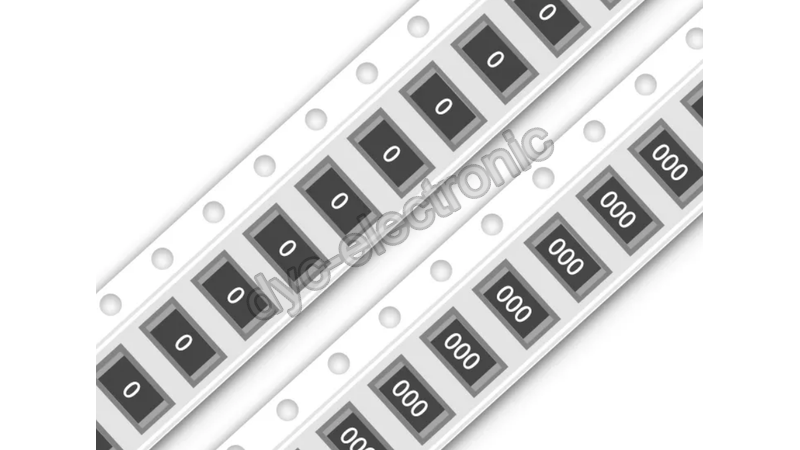
Look closely at almost any complex printed circuit board (PCB), and you’ll spot a dense row of components marked with a single “0” or “000”.
At first glance, it feels like a contradiction. A resistor’s entire job is to restrict current flow. So what is the point of a resistor that offers virtually no resistance? Are they just there to pad out the component count, or is there a clever engineering reason behind them?
Far from being useless, the 0-ohm resistor is one of the most versatile, cost-saving tools in modern hardware design. Let’s break down why they are everywhere, how they actually behave in the real world, and when not to use them.
1. Is a 0Ω Resistor Actually 0 Ohms?
Let’s clear up the biggest misconception right away: No, a 0-ohm resistor is not an ideal short circuit.
Nominally rated at 0Ω, it is manufactured just like a standard surface-mount (SMD) thick-film resistor, minus the resistive paste layer. In reality, its true resistance falls within tens of milliohms (≤ 50 mΩ), depending on the manufacturer and package size. That resistance is usually low enough to ignore, but it’s far from zero.
Because they are built like standard resistors, they have real power and current limits determined by their package size:
-
0402: ~1A / 1/16W
-
0603: ~2A / 1/10W
-
0805: ~3A / 1/8W
-
1206: ~4A / 1/4W
Note: Always verify exact ratings against the manufacturer’s datasheet before pushing limits.
2. What Problems Do 0-Ohm Resistors Actually Solve?
Engineers don’t place 0Ω resistors randomly; they serve distinct functions that save time, board space, and manufacturing costs.
① The Automated Jumper
On single- or double-sided boards where routing traces cross paths, you could use a hand-soldered wire jumper. But hand-soldering slows down assembly. A 0Ω resistor drops into place during standard Surface Mount Technology (SMT) pick-and-place lines without manual intervention. It’s the ultimate “last resort” when a trace gets trapped during layout: route everything else first, then bridge the final bottleneck with a 0Ω part.
② Version Control & Configuration
Want to build three different product variations using the exact same PCB? Enter the 0Ω resistor as a configuration switch. By populating or omitting a specific 0Ω resistor on the production line, you can change device modes, select master clock sources, or switch between protocols (like SPI or I2C). This allows companies to keep a single master PCB design and differentiate models purely via the Bill of Materials (BOM), avoiding expensive board respins.
③ Test Points and Isolation Nodes
Need to measure the current draw of a specific subsystem? Pop off the 0Ω resistor and slide an ammeter in series. They also excel at isolating analog and digital grounds—dropping a 0Ω resistor at a single-point connection lets you easily disconnect domains for debugging, offering more mechanical flexibility than a fixed trace or ferrite bead.
④ Weak Current Limiting & Emergency Fuses
In low-cost designs, a large-package 0Ω resistor can act as a sacrificial “one-time fuse” that blows during an unexpected overcurrent event. While dedicated fuses are always better for safety-critical circuits, a 0Ω resistor can successfully isolate a failing power branch during bench diagnostics.
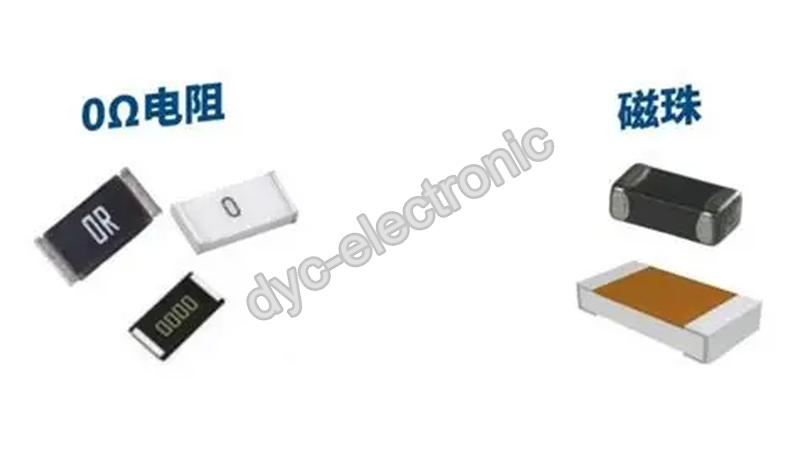
3. 0Ω Resistor vs. Ferrite Bead vs. Inductor vs. Jumper
It’s easy to confuse a 0Ω resistor with other passives. Here is how they compare in practice:
| Component | DC Resistance | High-Frequency Behavior | Typical Use Case |
| 0Ω Resistor | ≤50mΩ | Has parasitic inductance (~1nH); non-ideal at high frequencies | Jumpers, configuration options, test nodes |
| Ferrite Bead | Milliohm range | High impedance at high frequencies; absorbs high-frequency noise | Power and signal noise suppression |
| Inductor | Milliohm to Ohm range | Blocks high frequencies, passes DC/low frequencies | Power filtering, chokes, energy storage |
| Hand Jumper | Near 0Ω | Varies based on wire geometry | Prototyping, manual board modifications |
The takeaway: A 0Ω resistor is a nearly-shorted resistor, not a filter. It does not selectively eat high-frequency noise like a ferrite bead, nor does it block AC like an inductor.
4. Selection and High-Frequency Pitfalls
When designing with 0-ohm resistors, keep these engineering constraints in mind:
-
Match the Package to the Current: Never use a tiny 0402 package to carry 3A of current, or you’ll risk thermal damage.
-
High-Speed Limitations: A chip resistor packs roughly 1nH of parasitic inductance. At GHz frequencies or high-speed edge rates, that tiny inductance is not an ideal short. It can trigger ground bounce, compromise signal integrity, and disrupt controlled impedance traces. Avoid placing them on critical high-speed transmission lines.
Frequently Asked Questions
Is a 0Ω resistor’s resistance truly zero?
No. It typically measures between 10mΩ and 50mΩ. It functions as a standard SMT component with a resistance low enough to be neglected in most low-frequency circuits.
Can a 0-ohm resistor act as a fuse?
Only in very low-cost, non-critical scenarios. While large packages (like 1206) will open-circuit under heavy overcurrent, you should always use a proper safety fuse if overcurrent protection is required.
Why are there so many 0Ω resistors in my BOM?
They are almost always used for configuration flexibility (letting one PCB serve multiple product tiers), routing bottlenecks, or diagnostic test points—never as accidental padding.
Why shouldn’t I use them on high-speed RF boards?
Their built-in parasitic inductance (~1nH) causes reflections, ground bounce, and impedance mismatches at high frequencies. Treat them as small inductors, not ideal shorts, in RF design.
 العربية
 English
 Русский
 Français
 Deutsch
 日本語
 한국어
 Español
 Português
 Türkçe
 Italiano
 Polski
 Dansk