
A BGA sits on a medical control board with 400 balls hidden under the body. The AOI vs X-ray inspection question stops being academic the moment a line operator waves the board past the optical camera and it passes — while a 22% void sits inside ball 137, invisible to any lens. We have watched that exact escape reach a customer only once, and it cost a recall. This guide explains, defect by defect, what each method actually sees so you can spec the right coverage before it matters.
Engineer’s Note: Treat AOI as proof the board looks right, not that it is right. A clean optical pass says nothing about the joints you cannot see.
What AOI Actually Catches on the Surface
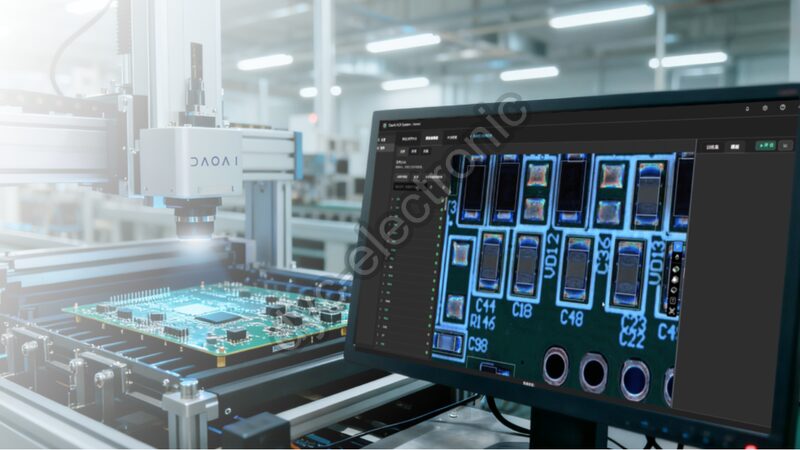
Short answer: AOI catches everything a camera can see — missing parts, wrong rotation, polarity, tombstones, lifted leads, and surface solder bridges. It is fast, cheap per board, and ideal for 100% inline coverage of visible defects. In practice we run it after paste print, after placement, and after reflow.
Modern 3D AOI adds a height map through structured light or laser triangulation. That improvement lets it quantify coplanarity and lifted leads far better tha=n flat 2D imaging. Here is the catch: 3D AOI is still an optical system. It measures Z-axis on the surface, but it cannot look through a package body.
Procurement Tip: Asking “do you have AOI” is not enough. Ask whether it is 2D or 3D, and at which stages it runs. IPC-9716 governs AOI process control, so a mature shop can show you program revision and false-call data, not just the machine on the floor.
What X-Ray Inspection Reveals Under the Package
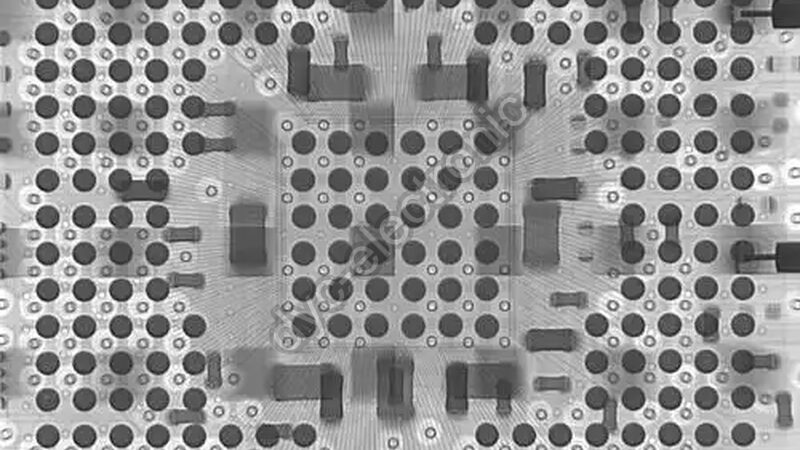
Short answer: X-ray (AXI) sees the joints AOI cannot — voids inside BGA balls, head-in-pillow, insufficient solder under QFN/LGA bodies, and hidden bridges. It penetrates the component and images the internal solder volume. For area-array packages this is the only non-destructive way to confirm a joint exists at all.
We reach for automated x-ray inspection whenever a design carries BGA, QFN, LGA, PoP, or a thermal pad under a bottom-terminated part. In practice, AXI flags around 90% of the total defect spectrum on a board, including opens and insufficient-solder conditions that pass electrical test but fail later in the field.
Field Lesson: One voided BGA ball on a power device can take down a whole module. The inspection that catches it costs minutes; the field return costs a brand.
AOI vs X-ray inspection: A Defect-by-Defect Comparison
The two methods are complementary, not competitors. The AOI vs X-ray inspection split below maps each defect to the method that catches it, so use the table as your quick reference when you write the inspection clause in a purchase order.
| Defect | AOI | X-Ray (AXI) | Verdict / Best for |
| Missing or wrong component | Yes | Yes | AOI — faster per board |
| Surface solder bridge | Yes | Yes | AOI — directly visible |
| BGA / QFN solder voids | No | Yes | X-ray only |
| Head-in-pillow (HiP) | No (2D blind) | Yes (angled / 3D) | X-ray only |
| Insufficient solder under BGA | No | Yes | X-ray only |
| Tombstoning / lifted lead (visible) | Yes | Yes | AOI first pass |
| Polarity / marking read | Yes | Limited | AOI |
| Through-hole fill | Partial | Yes | X-ray |
Industry references split the catch rates roughly 70% of assembly defects to surface AOI and 30% to hidden-joint X-ray, while a combined AOI-plus-X-ray strategy reaches above 95% coverage on a typical SMT line. Notably, the hidden 30% is the fraction most likely to cause a field failure.
Why 2D X-Ray Still Misses Head-in-Pillow
Short answer: a top-down 2D X-ray image stacks the ball and the paste into one dense mass, so a head-in-pillow separation hides behind an oxide layer. You need an angled view (45°–70°) or 3D laminography to see the “snowman” signature. Most production lines run only 2D AXI, which is excellent for macro voids but unreliable for HiP.
We therefore add a 2.5D angled scan for any BGA 15 mm or larger diagonally, and reserve 3D CT for first-article and field-failure work. The cost is cycle time, not capability. Skip the angle and you will clear a HiP joint that is, in truth, an open circuit waiting for mechanical stress.
Do You Need Both AOI and X-Ray on Your Line?
Short answer: yes if your board carries array packages, serves a high-reliability market, or both. For a simple prototype with only visible joints, AOI plus flying-probe testing is enough. For medical, automotive-safety, aerospace, or power RF modules, X-ray moves from optional to mandatory.
Consequently, our line pairs 6 Yamaha YS high-speed SMT placement lines with 6 AOI stations and dedicated X-ray capacity, so BGAs and QFNs get internal verification rather than a hopeful optical pass. Read our deeper guides on automated optical inspection and X-ray inspection for the equipment-level detail behind each method.
Cost Note: Equipment cost tracks the capability gap. Industry references put an AOI line near
50k–200k and an AXI system near200k–500k (RF Essentials, 2026). The right question is not the machine price — it is the cost of one escaped BGA void in your product class.
What to Ask Your PCBA Partner About Inspection
Short answer: turn the table around and audit the process, not the brochure. Ask which standard governs acceptability (IPC-A-610), whether X-ray is mandatory for your BGA/QFN classes, and whether defect images link to serial-number traceability. A shop that answers these concretely is one you can trust with Class 3 work.
Request the void acceptance rule in writing. IPC-A-610 (Rev H) caps total void area at 25% of the individual ball cross-section for both Class 2 and Class 3. Many high-reliability OEM specs tighten the interface to 10% or less, because a small interfacial void is a crack-initiation site regardless of total area. Pin that number down before you sign.
Engineer’s Note: A supplier that says “we inspect everything” without naming the standard, the stage, and the report format is describing hope, not a process.
FAQ
Can AOI replace X-ray for BGA inspection?
No. AOI confirms a BGA is present and positioned, but it cannot see under the body. The balls sit beneath an opaque package, so voids, head-in-pillow, and hidden bridges stay invisible to any camera. X-ray is the only non-destructive check for those joints.
What void percentage is acceptable per IPC-A-610?
IPC-A-610 (Rev H) allows up to 25% void area per ball for Class 2 and Class 3 alike. Class 3 adds documentation burden and OEM overlays often demand 10% or less at the interface. Always confirm the exact limit your contract specifies, because “Class 3” alone does not state the interfacial number.
How much does X-ray inspection add to cost?
X-ray adds cycle time and capital cost, not a simple per-board fee. Industry references place AXI systems several times above AOI in equipment price (roughly 200k–500k vs. 50k–200k). On a per-board basis the premium is usually small and justified the moment a BGA or QFN carries reliability risk.
Do you provide X-ray reports with serial-number traceability?
You should expect yes for any high-reliability build. Ask for archived defect images and pass/reject decisions tied to the board serial number, which supports root-cause work and customer audits.
Free DFM and Inspection-Plan Review
Getting the AOI vs X-ray inspection balance right starts with the design. If your board carries BGAs, QFNs, or power devices, send us the Gerbers and BOM. Spancer Huang and our engineering team will return a free DFM review plus a recommended inspection plan — AOI stages, X-ray scope, and the IPC class to specify — within one working day. Reach us on WhatsApp at +86 15818610980 or by email at info@dyc-electronic.com.
DYC Electronic runs 6 Yamaha YS high-speed SMT lines, 6 AOI stations, 2 lead-free DIP lines, and 2 conformal-coating lines, with 300+ staff and 20+ R&D engineers across a 5,000 m² plant.
 Italiano
  English
  Русский
  Français
  Deutsch
  日本語
日本語  한국어
한국어  Español
  Português
  العربية
  Türkçe
  Polski
  Dansk
Dansk