
A customer once sent a drawing marked only “IPC standard, high quality.” Their assembler built to Class 2, the industry default, and the first field returns came from a ventilator program that should have been Class 3 from day one. IPC-A-610 Class 3 is the high-reliability workmanship standard: it demands 100% inspection, complete solder wetting, and void limits roughly half of what Class 2 allows. Choose it when a failure can hurt someone or ground a system — medical life-support, aerospace, defense, automotive safety. For industrial controls, telecom, and commercial electronics, Class 2 is the right call.
Short answer up front: IPC-A-610 Class 3 is not a premium badge you buy for confidence. It is a tighter acceptance bar that only pays for itself when the consequence of failure is severe. Specifying it where it is not needed adds cost with no reliability gain; omitting it where it is needed hides a field-failure risk you cannot see at the receiving dock.
What Is IPC-A-610 Class 3?
Short answer: IPC-A-610 (“Acceptability of Electronic Assemblies”) sorts products into three classes by reliability need, and Class 3 is the strictest. The current revision is Rev J, released in 2024; there is no Rev I, because the letter was skipped to avoid confusion with the number 1. Rev K is already in draft.
The standard is the most widely used visual acceptance reference for assembled boards. It covers solder joints, component placement, cleanliness, coating, marking, and physical damage through hundreds of illustrated accept/reject examples. Rev J also removed the old “Target” condition category, which simplified judgment to three levels: Acceptable, Process Indicator, and Defect. That change closed a long-running gray zone where a joint could be “not ideal but not defective.”
| Class | Reliability need | Typical products | Inspection |
| Class 1 | Function only; failure is a nuisance | Toys, remotes, disposable IoT | Minimal |
| Class 2 | Extended life; service desired, not critical | Industrial controls, telecom, commercial, auto non-safety | Sample-based (AQL) |
| Class 3 | Performance-on-demand; downtime unacceptable | Medical life-support, avionics, defense, space, auto safety | 100% |
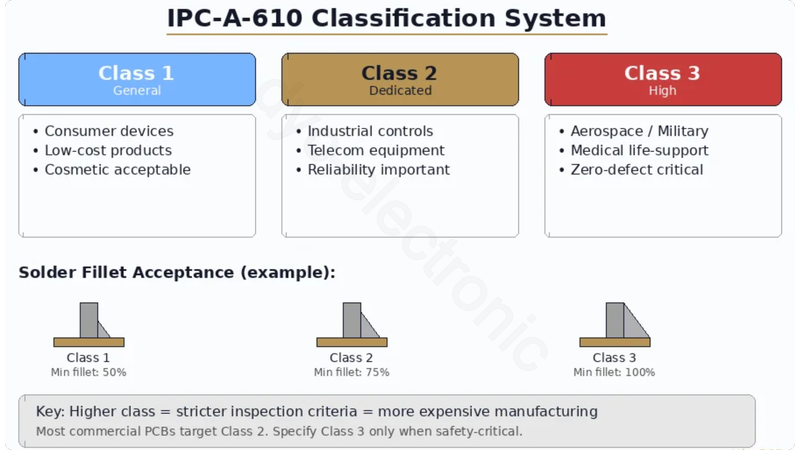
Class 2 covers roughly 70% of assemblies built worldwide, and most contract manufacturers default to it when a purchase order is silent. That default is exactly why you should state the class yourself.
How IPC-A-610 Class 3 Differs from Class 2
Short answer: Class 3 takes the same criteria and tightens the numbers. In practice, the biggest gaps are solder wetting, component overhang, BGA voids, ionic cleanliness, and inspection coverage. A condition that is merely a Process Indicator at Class 2 becomes a Defect at Class 3.
The detailed criteria comparison below is what inspectors actually apply day to day:
| Criterion | Class 2 | Class 3 |
| Through-hole wetting | ≥75% solder-side, circumferential not required | 100% circumferential + ≥75% barrel fill |
| Chip overhang (0402–2512) | ≤50% of pad width or 0.5 mm | ≤25% of pad width or 0.25 mm |
| Chip overhang (0201) | ≤25% | ≤10% |
| BGA void area | <25% of ball diameter | <10% of ball diameter (some specs 4–9%) |
| Ionic cleanliness | ≤1.56 µg NaCl eq./cm² | ≤0.78 µg NaCl eq./cm² or SIR testing |
| Solder balls | ≤5 per 600 mm² | ≤3 per 600 mm², none within 0.13 mm of a conductor |
| Component tilt | ≤25° | ≤10° |
| Exposed copper on PTH barrel | Acceptable | Not acceptable |
| Bow / twist | ~1.0–1.5% | ≤0.75% |
| Inspection coverage | Sample (AQL 1.0–2.5) | 100% visual + X-ray on BGA/QFN |
Critically, BGA and bottom-terminated joints sit under the component body, so no visual check can grade them. Class 3 pairs its criteria with mandatory X-ray on every ball, which is why a combined AOI and X-ray plan is the practical inspection strategy for high-reliability builds rather than AOI alone.
When Is IPC-A-610 Class 3 Mandatory?
Short answer: when the product specification or the regulatory regime calls it out. Medical class IIb and III devices under IEC 60601 and ISO 13485, defense work under MIL-PRF-31032 or the J-STD-001 space addendum, and aerospace under AS9100 all point at Class 3. Industrial safety loops rated SIL 2–3 depend on the integrator’s contract.
The trigger list is short and specific: implantable and life-support medical devices, flight-control avionics, weapons and space systems, nuclear plant controls, and safety-critical automotive electronics such as ADAS, airbags, and ABS. Conversely, general industrial equipment, telecom, consumer wearables, EV chargers outside the safety path, automotive infotainment, and commercial IoT all belong at Class 2. Specifying Class 3 there buys inspection cost, not durability.
Engineer’s Note: A field failure is not always a workmanship failure. IPC-A-610 grades what the assembly looks like, not whether the circuit works — a visually perfect board can still fail a functional test.
What Does IPC-A-610 Class 3 Cost?
Short answer: expect a premium of roughly 8–40% over Class 2 assembly, depending on inspection scope and complexity. The spread is wide because the premium is driven by labor and documentation, not materials. On a €15 board at 1,000 units, that works out to about €1,200–3,000 across the order — trivial on a €2,000 medical device, ruinous on a €40 industrial sensor.
Where the premium goes is consistent across industry summaries. Slower 100% inspection takes the largest share at roughly 35–45%, followed by certified operators (IPC CIS/CIT trained) at 15–20%, tighter rework loops at 15–20%, documentation and traceability at 10–15%, and material upgrades for cleanliness at 10–15%. Class 2 to Class 1 economics run the other way, which is why Class 2 is the default: it is the point where added inspection stops paying for itself on ordinary commercial hardware.
How to Specify IPC-A-610 Class 3 on Your Drawings
Short answer: state document, revision, and class together, and pair the acceptance standard with the process standard. A callout that names only “IPC-A-610” leaves the revision and class ambiguous, and ambiguity is what produces disputes at delivery.
A complete Class 3 callout looks like this:
Two companion standards matter here. IPC J-STD-001 specifies the soldering process — how the joint is built — while IPC-A-610 judges the finished result, so a rigorous spec references both at the same class. IPC-A-600, by contrast, governs the bare board before assembly, and mixing it up with IPC-A-610 is a common sourcing error. Confirm your partner’s inspectors hold CIS or CIT certification for the revision you require; CIS certificates lapse after two years without recertification.
A Practical Checklist for Specifying IPC-A-610 Class 3
Short answer: decide the class at design freeze, not at the shortage or the first quality escape. Five steps keep the decision deliberate. Ultimately, the class you write on the drawing sets the baseline reliability of everything downstream.
- Score the consequence of failure — nuisance, planned downtime, or harm/loss of mission.
- Map the product to its regime: ISO 13485 and IEC 60601 for medical, AS9100 for aerospace, safety SIL for industrial.
- Write the callout with document, revision (Rev J, 2024), and class together.
- Pair it with IPC J-STD-001 at the same class and define where AOI and X-ray apply.
- Require full lot traceability and 100% inspection records for Class 3 shipments.
Those records feed straight into incoming quality control on your side, and they complement — never replace — electrical verification such as PCBA functional test, because IPC-A-610 says nothing about whether the circuit works.
FAQ
What is the difference between IPC-A-610 Class 2 and Class 3?
Class 2 requires extended life with uninterrupted service desired but not critical, and is inspected on a sample basis. Class 3 applies where performance-on-demand is critical, and it tightens the numbers: complete through-hole wetting, half the chip overhang, BGA voids under 10% instead of 25%, and 100% inspection.
Is IPC-A-610 Class 3 required for medical devices?
It is required for medical class IIb and III devices — implantables and life-support equipment — under IEC 60601 and ISO 13485. Non-life-support medical hardware can often stay at Class 2 if the risk file supports it.
Does IPC-A-610 Class 3 cost more?
Yes. Industry summaries put the premium at roughly 8–40% over Class 2 assembly, driven mostly by 100% inspection, certified operators, rework loops, and traceability documentation rather than by materials.
Does passing IPC-A-610 mean the board works electrically?
No. IPC-A-610 is a visual workmanship acceptance standard covering solder joints, placement, cleanliness, and damage. Electrical function is verified separately through ICT or functional test, so high-reliability builds use both.
Conclusion
Overall, IPC-A-610 Class 3 is a deliberate reliability decision, not a quality upgrade you order by default. It demands 100% inspection, complete solder wetting, BGA voids under roughly 10%, and ionic cleanliness at half the Class 2 limit — and it typically costs 8–40% more in assembly. Reserve it for medical life-support, avionics, defense, and automotive safety; keep industrial, telecom, and commercial work at Class 2. Either way, write the document, revision, and class on the drawing so the factory has no room to guess.
At DYC Electronic, our 6 Yamaha YS SMT lines and 6 AOI stations run trained inspectors on both Class 2 and Class 3 workmanship, with full lot traceability on every Class 3 shipment.
Talk to Spancer Huang on WhatsApp +86 15818610980 or email info@dyc-electronic.com for a free DFM review and a competitive quote — and tell us which IPC class your drawing needs before your next build freezes.
 العربية
  English
  Русский
  Français
  Deutsch
  日本語
日本語  한국어
한국어  Español
  Português
  Türkçe
  Italiano
  Polski
  Dansk
Dansk