
A 470 µF capacitor sits on the bottom side of a dual-layer board. Halfway through the second reflow pass, gravity wins and the part drops onto the conveyor belt. That is not an STM32 or ESP32 problem, but it illustrates how a single component choice cascades into PCBA assembly yield, test fixture design, and field reliability. When engineers ask us about STM32 vs ESP32, they are rarely asking which chip has more CoreMark points. They are asking which one keeps their product shippable, certifiable, and orderable for the next decade.
In our builds, we have seen both platforms succeed and fail for reasons that never appear in a datasheet summary table. The honest answer turns on four questions: do you need integrated Wi-Fi, how tight is the power budget, does the product require functional safety certification, and how long must it stay in production without a forced redesign? This guide compares them on the criteria that actually decide PCBA outcomes.
Two Different Design Philosophies for PCB Layout
The ESP32 exists to put a device on a network cheaply. Espressif describes it as a connectivity-first SoC aimed at IoT applications where the radio is the reason the part exists [1]. For PCBA designers, this means fewer RF components on the board when using pre-certified modules, but also less flexibility in antenna placement.
Conversely, the STM32 family spans 1,644 Arm Cortex-M part numbers across high-performance, mainstream, ultra-low-power, and wireless lines [3]. Wireless is one branch, not the trunk. That difference propagates into everything from decoupling capacitor count to test point allocation. An ultra-low-power STM32 reaches 530 nA standby while the ESP32 stops at 10 µA in deep sleep [1][11], and ST ships a certified functional safety package while Espressif ships a Wi-Fi stack [16].
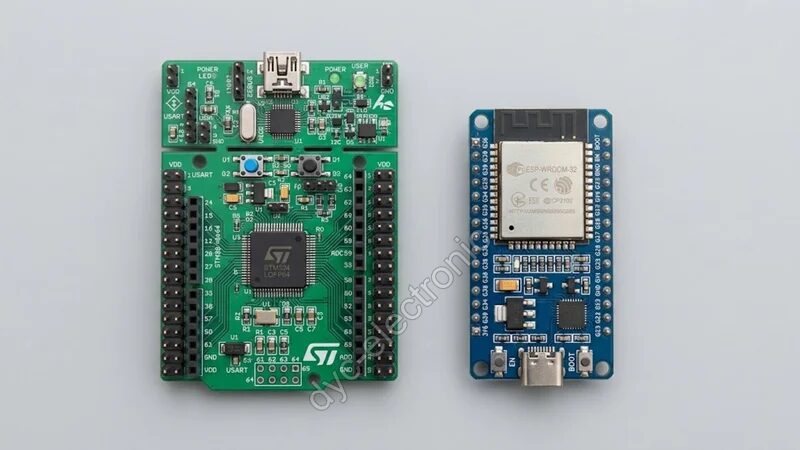
Figure 1: Physical footprint and peripheral routing differ significantly between the two families, affecting panel utilization and test access.
Engineer’s Note: If your product needs Wi-Fi and nothing else matters, start with ESP32. If it needs deterministic motor control, sub-GHz telemetry, or SIL2 safety evidence, start with STM32. Everything else is secondary.
Architecture Benchmarks That Matter Beyond CoreMark
Clock speeds mislead procurement teams. The ESP32 scores 1,079.96 CoreMark on two cores at 240 MHz [1], while the STM32N6 reaches 3,360 from a single 800 MHz Cortex-M55 [3]. But most designs on either side are nowhere near compute-bound. Treat processing power as a filter that rules parts out, not as a ranking.
Actually, the real-time performance argument for STM32 is less about instructions and more about interference. On an ESP32, Wi-Fi and Bluetooth stacks share the CPU with your application. Radio activity has timing consequences you do not fully control. On an STM32 driving a motor or reading a precision ADC, nothing competes for interrupt latency. If your PCBA includes closed-loop control, that isolation prevents field returns.
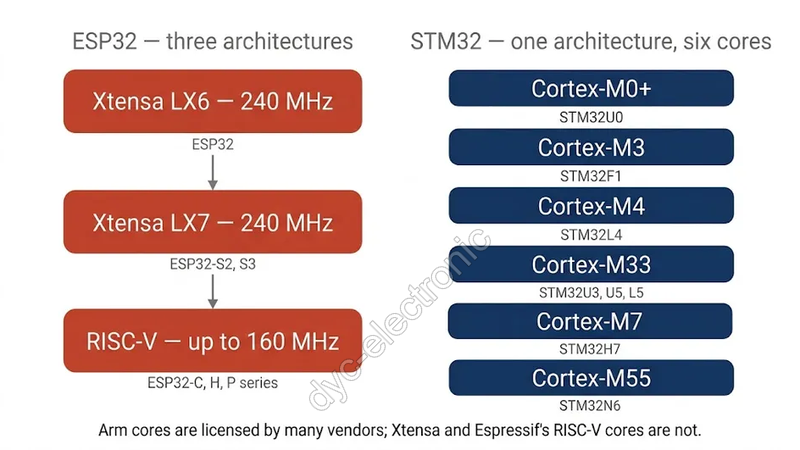
Furthermore, toolchain portability favors Arm Cortex-M. CMSIS libraries, RTOS ports, and debug probes move across vendors. Espressif’s Xtensa and RISC-V parts are well supported inside ESP-IDF but much less so outside it [5]. For contract manufacturers maintaining multiple customer products, this reduces NRE and training overhead.
Wireless Connectivity: The Decisive PCBA Difference
The ESP32 integrates 802.11 b/g/n Wi-Fi and Bluetooth on-die [1]. The newer ESP32-C6 adds Wi-Fi 6 and Thread/Zigbee support [5]. For smart home endpoints needing Matter compliance, this single-chip integration simplifies BOM management and reduces RF layout risk.
However, no STM32 has Wi-Fi on the die. ST covers Bluetooth LE, Zigbee, Thread, and sub-GHz via dedicated wireless MCUs like the STM32WL and STM32WBA series [9]. Wi-Fi requires a separate coprocessor module such as the ST67W611M1 [6]. That is a second part, a second interface, and more board area.
Critically, the classic ESP32-WROOM-32 module is now marked Not Recommended For New Designs (NRND) [15]. Tutorials have not caught up with the datasheet. Before committing a footprint, verify module status in Espressif’s product selector. We have seen three projects in 2026 alone face mid-design module obsolescence because sourcing teams trusted outdated blog posts.
Power Consumption: Sleep States Versus Duty Cycle Reality
Sleep mode names differ between vendors. Match states by what stays powered, not by the label. The STM32U575 draws 530 nA in Standby with RTC running, against 10 µA for ESP32 deep sleep [1][11]. That is roughly a twentieth of the current on paper.
Here’s the catch: these are typical datasheet values at stated conditions. Boards behave worse than dies. Regulators, USB-UART bridges, and indicator LEDs on a development board can swamp both figures. And the comparison is not like-for-like because the STM32U575 has no radio. A fairer single-chip number is ST’s STM32WL5x at 1.07 µA in Stop mode with full retention and radio included [21]. Still well under ESP32, but harder to argue with.
For battery products waking more than a few times per hour over Wi-Fi, radio transmission dominates the budget. The MCU sleep floor barely registers. Choose on other criteria. For coin-cell sensors measured in years, the gap between 530 nA and 10 µA decides whether you ship a product or a recall.
Peripherals and Analog Fidelity for Precision PCBA
The ESP32 offers 34 programmable GPIOs, but five are strapping pins and six are input-only [1]. On modules with in-package flash, another six pins vanish. Usable pin count catches people out during prototype-to-production transition.
On analog output, the ESP32 DAC is only 8-bit (256 levels). This is coarse for anything beyond crude reference voltages. If your PCBA requires clean analog output for sensor calibration or audio, check the specific STM32 part’s DAC resolution. The STM32U575 provides two 12-bit DACs plus op-amps with PGA [11].
Additionally, motor control still favors STM32. The U575 carries two dedicated advanced-control timers among seventeen total [11]. While ESP32 MCPWM supports dead-time insertion and fault shutdown, channel count and determinism matter. Radio stacks sharing the CPU introduce jitter that breaks tight control loops. ST’s motor-control software ecosystem is also more developed, which often decides project schedules rather than datasheet lines.
Development Ecosystem and Production Toolchains
ESP-IDF releases are supported for only 30 months [12]. Plan framework migrations accordingly. Espressif maintains its own Arduino core covering most ESP32 variants [8], making rapid prototyping genuinely fast.
On the ST side, STM32CubeIDE now ships in Eclipse-based and VS Code-based variants, with ST focusing resources on the latter [13]. STM32CubeMX is now a standalone install. Arduino support comes through community-maintained STM32duino, requiring IDE 2 since core release 2.8.0 [14]. Note the provenance difference: Espressif’s Arduino core is a vendor deliverable; STM32duino is not. That decides who fixes bugs and how soon new parts get support.
For certification bodies expecting qualified compilers, third-party toolchains like IAR and Keil MDK matter mostly on STM32. PlatformIO and MicroPython suit quick IoT projects better than C does on ESP32.
Procurement Tip: When evaluating PCBA Assembly Services, ask whether the factory has experience with both toolchains. Cross-platform familiarity reduces handoff friction during design-for-manufacturing reviews.
Certification, Safety, and Longevity Commitments
If your product needs a safety argument, STM32 has one and ESP32 does not. ST publishes X-CUBE-STL for IEC 61508 SIL2/SIL3, TÜV Rheinland certified [16]. SIL2 functions use a single MCU; SIL3 requires two in 1oo2 scheme. Budget accordingly. Coverage includes F0/F1/F3/F4/F7/G0/G4/H7/L0/L4/L4+/L5/WL series plus MP1. The U5, U3, H5, WBA, and N6 are not covered [16]. If safety certification is required, this narrows part choice before any other criterion.
On longevity, Espressif commits 12–15 years per SoC family with fixed end dates (ESP32 until Jan 2031, ESP32-S3 until Jan 2033) [17]. ST runs a tiered program with annual renewal. STM32F103C8, in production over a decade, is listed Active until January 2036 [18]. Per-part rolling guarantees present a different risk profile than fixed family end dates for products with 10+ year service lives.
For medical devices, industrial automation, and machinery, functional safety evidence is not a bonus feature. It is the difference between a viable certification path and a complete rewrite. Our DFM Analysis service flags safety-capable part gaps early, preventing late-stage redesigns.
Common Mistakes We See in PCBA Projects
Assuming ESP32 means Xtensa. The C6 and siblings are RISC-V [5]. Verify the core before assuming library compatibility.
Designing in the classic WROOM-32. It is NRND, along with WROVER and WROOM-32D/U [15]. Check module status before routing.
Treating ESP32 GPIO count as usable pin count. Six are input-only, five are strapping, and six go to SPI flash on modules [1]. Read pin restrictions first.
Expecting 8-bit DACs to handle precision analog. Check this parameter early if audio or control accuracy matters [1].
Comparing sleep modes by name instead of powered state. Match what remains active, then compare currents.
Planning a 10-year product on a 30-month framework. ESP-IDF support windows force migrations [12]. Budget engineering time.
Frequently Asked Questions About STM32 vs ESP32
Is STM32 more powerful than ESP32 for PCBA designs?
Yes, at the top of the range. The STM32N6 reaches 3,360 CoreMark [3] versus 1,079.96 for dual-core ESP32 [1]. But “STM32” is not a single performance level. Compare specific part numbers against your actual workload, not benchmark peaks.
What is the main difference between STM32 and ESP32 for sourcing?
Integrated Wi-Fi. ESP32 has on-die 2.4 GHz Wi-Fi and Bluetooth [1]; no STM32 does. ST covers other protocols via dedicated wireless MCUs [9]. For Wi-Fi designs, ESP32 simplifies BOM unless safety or determinism demands STM32 plus external radio.
Which uses less power in battery-powered PCBA applications?
Ultra-low-power STM32 uses far less in standby: 530 nA versus 10 µA for ESP32 deep sleep [1][11]. But that STM32 figure is MCU-only. In active Wi-Fi operation, radio transmission dominates. Sleep current matters only when duty cycles are very low.
Can I use Arduino IDE with both for rapid prototyping?
Yes. Espressif maintains its own Arduino core [8]; STM32duino is community-maintained and requires IDE 2 [14]. Both work for prototyping, but vendor-supported cores reduce risk in production transitions.
Does ESP32 support CAN bus for industrial PCBA?
Yes, via TWAI compatible with ISO 11898-1 classical frames [1]. It lacks CAN FD; for that, use STM32 with FDCAN or newer ESP32-C5. External transceivers are required on both platforms.
Is ESP32 suitable for industrial IoT PCBA projects?
Often yes, but limits exist. No functional safety package, shared CPU with radio stacks affecting hard real-time determinism, and NRND status on classic modules [15][16]. Evaluate against your specific certification and latency requirements.
Ultimately, the STM32 vs ESP32 decision hinges on connectivity, power budget, certification path, and service life—not raw specs. Pick on those four axes, and the rest follows. Need help validating your component choices before tape-out? Request a free DFM review to catch obsolescence, safety, and assembly risks early.
 العربية
  English
  Русский
  Français
  Deutsch
  日本語
日本語  한국어
한국어  Español
  Português
  Türkçe
  Italiano
  Polski
  Dansk
Dansk